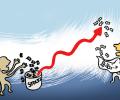
In a dazzling resurgence, foreign investors have graced the Indian equity markets with an influx of nearly Rs 1.5 lakh crore in 2023, fuelled by optimism over the country's resilient economic fundamentals amid shadows of a gloomy global scenario. Experts believe that the positive trend may continue in 2024. This follows Indian equities witnessing the worst-ever net outflow of Rs 1.21 lakh crore by FPIs in 2022 on aggressive rate hikes by the central banks globally after net inflows for three consecutive years.

India and China, besides some developed countries, may face economic downturn in the coming months, according to an analysis by OECD -- a grouping of mostly advanced nations.
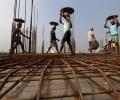
The review will not only present data, trends but also list out the achievements of the Narendra Modi government

'As China's reopening euphoria fizzled out on the back of some disappointing economic data, we saw inflows coming back to India with full force in the past 3-4 months.'

Global trends and trading activity of foreign investors would largely dictate terms in the equity markets this week amid a lack of major domestic triggers, analysts said. Markets may face near-term consolidation due to elevated valuations, they noted. "While the previous week was predominantly shaped by developments in the US Federal Reserve policy, attention will now shift to the Bank of Japan's policy decision on December 19," Santosh Meena, Head of Research, Swastika Investmart Ltd, said.

The global economy is projected to expand by 4.2 per cent this year, but rising oil and commodity prices and European debt crisis could hurt the overall recovery, according to Paris-based think-tank OECD.

Among the Sensex firms, Larsen & Toubro, UltraTech Cement, JSW Steel, Titan, Bajaj Finance, Wipro, Tech Mahindra and Nestle were the major laggards. Maruti, Power Grid, Axis Bank, State Bank of India, NTPC, HDFC Bank, ITC and IndusInd Bank were the gainers.

Fitch Ratings on Monday said the shock to economic activity from the latest wave of COVID-19 pandemic will be less severe than the one in 2020, but recovery is likely to be delayed as economic activity dropped in April-May. The global rating agency said there are growing indications that the latest wave of COVID-19 infections will add to risks among financial institutions (FIs) and anticipates that the Reserve Bank of India (RBI) may introduce additional measures to support the financial sector if indications of economic stress mount.

tailwinds of a remarkable year and handsome investor returns, Indian equities are set for an eventful journey in 2024, with a slew of local and global cues -- varying from interest rates to Lok Sabha polls to geopolitical happenings. Analysts are of the view that the bull run in the domestic equity market will continue, and over the next 3-6 months, the benchmark indices -- Sensex and Nifty -- could climb up to 7 per cent. In 2023, the 30-share BSE Sensex jumped 11,399.52 points or 18.73 per cent, and the NSE Nifty climbed 3,626.1 points or 20 per cent.

The International Monetary Fund expects India's economic growth rate to moderate to 7.5-7.75 per cent this fiscal, from 8.5 per cent in 2010-11, on account slowing investments and sluggish global recovery.

The Prime Minister's Economic Advisory Council (PMEAC) expects the economy to grow by over 7.2 per cent during the current fiscal and exceed 8 per cent in 2010-11, thanks to increased economic activity.
The downturn in commodities and oil refining, stemming from global economic slowdown, has affected profitability. This is expected to weaken the company's cash flow measures, S&P said.

Gandhi took a swipe at the government on Twitter by tagging a chart that showed IMF growth projections for 2020-21 for Bangladesh, Myanmar, Nepal, China, Bhutan, Pakistan, Sri Lanka, Afghanistan and India.
The IMF, in its latest World Economic Outlook report, also said India is among the economies that may require more tightening to address inflation pressure.
The IMF, in its latest World Economic Outlook report, also said India is among the economies that may require more tightening to address inflation pressure.
There is a significant risk that advanced economies could experience another downturn, said the World Economic Outlook report released on Thursday.

On an average, PMEAC said economic growth could be around 6.5 per cent.

Retail inflation fell to a 15-month low of 5.66 per cent in March, mainly due to a decline in food prices, government data showed on Wednesday. The inflation figure in March is within the RBI's comfort zone as it is below 6 per cent. The retail inflation based on Consumer Price Index (CPI) was 6.44 per cent in February 2023 and 6.95 per cent in the year-ago period.
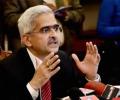
Reserve Bank Governor Shaktikanta Das has pitched for policy support from all sides -- fiscal, monetary and sectoral -- to nurture recovery of the economy hit by the second wave of the coronavirus pandemic. The dent on economic activity due to the second wave of the pandemic during April-May necessitated continuation of monetary measures to support the process of economic recovery to make it durable, Das had said while participating in the meeting of the Monetary Policy Committee (MPC) earlier in the month. "Overall, the second wave of COVID-19 has altered the near-term outlook, and policy support from all sides - fiscal, monetary and sectoral - is required to nurture recovery and expedite return to normalcy," Das said, as per the minutes of the meeting released on Friday.

Indian equity markets have a limited upside potential in the near-term as they negotiate the ensuing cyclical slowdown, wrote analysts at Nomura in a recent coauthored report led by Saion Mukherjee, their managing director and head of equity research for India. He, however, believes that the foundations are in place for sustainable growth over the medium-to-long term, and hence suggests a 'buy on dips' strategy to equity investors. As an investment strategy, Nomura prefers domestic-oriented sectors and companies over exporters, and prefers stocks that provide valuation comfort. Industrials and banks are their overweight sectors, while IT services and consumer discretionary are their underweight sectors.
.jpg)
Moody's became the first rating agency to retain the sovereign rating of Baa3 for the country after the rupee dived below 63 to the dollar, on Monday.

'For experienced and risk-taking investors, now may be the time to go all in.' 'By 'experienced and risk-taking', I refer to those who remained net buyers in equities during the early stages of the 2020 pandemic.' 'On the other hand, those who exited the markets during the pandemic may go the SIP way.'
Advanced economies are projected to grow by just 2.7 per cent in 2010 and 2.2 per cent in 2011, the IMF report said.

India's largest asset manager SBI Funds Management on Tuesday said they are negative on equities from a shorter-term perspective as valuations have risen above the comfort zone. "We are not positive on equities. We think valuations are expensive. "The market has gone up a lot more than the earnings have grown," said R Srinivasan, Chief Investment Officer (CIO) - Equity at SBI Mutual Fund, at the launch of asset management companies' (AMC) yearly report on the market outlook.

The indicator, designed to flag turning points in the economic cycle, suggested there was "stable growth momentum" in the bloc of mostly wealthy developed nations, the OECD said.
It forecast a growth of 9 per cent for 2011-12.

The Prime Minister's Economic Advisory Council on Friday said the economy will grow by 8.5 per cent, up from a projected 8.2 per cent, and inflation will come down from double digits to 6.5 per cent by the end of 2010-11.

Reflecting subdued global economic growth, India's outward foreign direct investment (FDI) fell by 33.3 per cent sequentially to $1.21 billion in August, compared to over $1.82 billion in July.

According to the Grant Thornton International Business Report, 45 per cent of businesses in the BRIC countries (Brazil, Russia, India and China) plan to increase investment in research and development over the next year, compared to just 18 per cent in the G7.

Buoyed by healthy farm output and narrowing current account deficit, India is the seventh most economically confident country in the world, a study by global research firm Ipsos has said.

An aggressive rate hike by the US Fed and the possibility of a recession can trigger a slide in these stocks, which will be a good opportunity to buy from a long-term perspective.

According to the BofA-ML Fund Manager Survey for January, asset allocators assigning more funds to equities than at any time since February 2011, while their confidence in the world's economic outlook has reached its most positive level since April 2010.
Revising its economic outlook, International Monetary Fund (IMF) today marginally brought down India's growth rate projections to 5.6 per cent for this fiscal and 6.3 per cent for the next financial year.
Returns from the yellow metal may be subdued, as focus returns to equities.

For the 2009-10 fiscal, Pranab said, he expects the economy to grow by 7.2 per cent.

The RBI has already hiked interest rates 12 times since March, 2010, to control inflation, which is currently hovering near the double-digit mark.
The panel, headed by former RBI governor C Rangarajan, in its economic outlook for 2007-08 also projected inflation to remain within 4 per cent.
India can raise funds through selling up to\n49 percent of its state-run firms, Montek Singh Ahluwalia, deputy chairman of the\nPlanning Commission, has said.
The Shanghai Stock Exchange has registered maximum fall (56 per cent) from its peak, while the benchmark index of the Bombay Stock Exchange dipped by as much as 40 per cent and the Manila Stock Exchange dropped by 39 per cent, registering the third largest fall. The report added that 'having lost one fifth to one third of their value, equity assets would appear to have greater upside rather than down side prospects.

Lower IT exports will raise India's dependence on capital flows to fund imports.
 © 2026 Rediff.com - Advertise with us - Disclaimer - Privacy Policy - Sitemap - Feedback - About us - Terms of use - Grievances